 The PGA National Resort and Spa was built on high hopes and high dreams, founded on the PGA of America’s high standards. Proof to this is the quality of its first course – the PGA National – Haig Course. Built in 1980 by Tom and George Fazio, and surrounded by several other high caliber golf courses, the Haig has remained to be amongst the finest in the resort and in the Palm Beach area. And with scenery all too unique to the Sunshine State, no room is left for questions and doubts as to why this is a favorite golf vacation destination.
Along with four other courses, the PGA National – Haig Course makes up the five courses of the PGA National Resort and Spa. It measures 6,806 yards from the longest tees, the third largest in the resort, and plays for a par of 72. The Fazio duo created the golf vacation haven to be playable and relaxing for all golfers, regardless of skill levels. And so the designers played on with the location of the water hazards. The result is a course that never requires a cross over water shot, giving the golfers more options for their shots.
Apart from that, the PGA National – Haig Course is also very versatile. Its 9th and 18th holes both lead to the clubhouse, giving the golfers an easy option for a full game or a shorter afternoon game before lounging at the clubhouse. This makes for golf trips that are fun at the most, relaxing the least, and perfect at its best. And all that are standing on the PGA of America’s standards on quality and excellence in the sport.
 Golfers can make an errant shot or two but not suffer for it for too long. The undulating fairways of this
  Florida, a close distance from Port St. Lucie and Stuart. The course measures 7,119 yards from the championship tees. It is from this distance that the course is at its worst – that is, if one is not into intimidating, grueling, but extremely rewarding games. But from the other tees, golfers must not expect anything less than tough. Of course, a Nicklaus design is always challenging. Double the Nicklaus part, and you’re sure to get double the difficulty. As well as everything else – ranging from fun to beauty. And that’s exactly
  hazards that make it attractive to tournament organizers. The
  Pete Dye’s taste in golf course architecture borders on the eccentric, sometimes being the subject of conservatives’ ire and criticism. The
  A paradise for wildlife as much as it is for golfers, the
  characterized by heavily-guarded greens, tight galleries with a good helping of pines and palms, and a lot of water in the holes. And by a LOT, it actually means water play on all but three of the 27 holes. And that comes with wind consistently blowing – a treacherous kiss to challenge any good golfer’s game and resolve. Everything that the golfing world enjoyed several decades ago in their
 Country Club
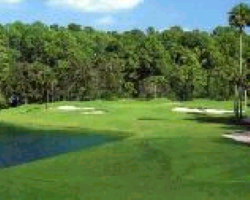
 fairways offer a widely open layout that can be more forgiving than other courses. Half of the holes are surrounded by numerous water hazards: ponds, creeks, canals, and lakes. The toughest trouble can be experienced around the greens and fairways that are encircled by white sand traps. If players overcome these hazards, they find themselves making an approach shot on the large undulated greens. But of course,
