The Cypress Course of the Emerald Greens Golf Resort features just nine of the fascination 27 holes of the resort, but it in itself is enough to satisfy a golf hungry golfer. Whether played as a short course, or paired with its adjacent nine-hole course, this nine has some of the best combination of scenery, challenging layout, and everything good about Tampa, Florida’s golfing scene. A golf vacation at the Emerald will never be complete without playing this course.
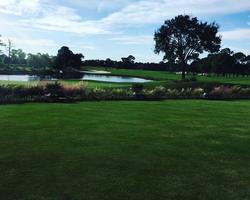
Measuring 3,555 yards, the Cypress Course of the Emerald Greens features a lot of water on its holes – as are the other two courses in  the facility. As its name implies, the course is surrounded by a dense growth of large cypress trees that make it more scenic. The greens on the Cypress nine are large and undulating, the bunkers vary between small pot bunkers and the large intimidating ones. Golf trips here are defined by the variety of games that could be played depending on the nines combination. The Cypress-Meadows is a favorite 18-hole combination for a game at the Emerald for the variety it offers, having larger greens on the Cypress, and relatively smaller greens from the Meadows.
The Cypress Course of the Emerald Golf Resort, along with the other two nines – The Meadows and The Pines, make up this favorite Tampa golf vacation destination. The facility also features double sided practice range, and putting and chipping greens. The courses were originally designed by Ed Ault in 1971, and was redesigned by Dan Maples in 2004.
 With the old growth pines lining the fairways, it does look shorter than it actually is, but there is nothing so simple and easy about it. Unlike in most other Florida course, golfers here do not have to worry about endless greens and gigantic water hazards in this golf course; they only have to battle the quick and undulating greens and unpredictable fairways. And they are not necessarily easy.
  And for every heartache and headache it causes the “thinking” golfer, it makes up for in beauty. The
  The PGA National Resort and Spa was built on high hopes and high dreams, founded on the PGA of America’s high standards. Proof to this is the quality of its first course – the
  Golfers can make an errant shot or two but not suffer for it for too long. The undulating fairways of this
  named after Rodman Wanamaker. For the uninitiated, Wanamaker is a total stranger. But to the golf historian, aficionado, and the true lover of the sport, Rodman Wanamaker’s name is synonymous to the PGA of America, as he inspired its birth in 1916. He is THAT much of a personality in the sport. The fact that the
  Along with the Ryder and Dye courses, the
  hazards that make it attractive to tournament organizers. The
  Pete Dye’s taste in golf course architecture borders on the eccentric, sometimes being the subject of conservatives’ ire and criticism. The
  A paradise for wildlife as much as it is for golfers, the
  characterized by heavily-guarded greens, tight galleries with a good helping of pines and palms, and a lot of water in the holes. And by a LOT, it actually means water play on all but three of the 27 holes. And that comes with wind consistently blowing – a treacherous kiss to challenge any good golfer’s game and resolve. Everything that the golfing world enjoyed several decades ago in their
